دسته‌ها

REGIONAL COURSE ON WATER QUALITY

چکیده:

Water of sufficient quantity and potable quality is essential for the economic, mental and physical health of a population. In most developing countries, water that is available for human consumption comes from rivers, lakes and groundwater resources. Quality of the water is mainly affected by the chemical composition of the parent rock and human activities in the watershed, such as farming, extent of human settlement and the discharge of human effluents. Fundamental knowledge of techniques employed in water quality monitoring and assessment is thus indenspensible in the sustained supply of good quality water.
The regional course provides participants with an opportunity to gain a fundamental understanding of fate and impact of chemical pollutants in the environment, enabling them to make an environmental risk assessment for water quality. Participants will be able to link ground- and surface water quality to natural factors, land use and specific anthropogenic sources in the watershed. Further, they will acquire advanced practical skills in water sampling, analysis and interpretation of data, including chemical speciation and modelling with PHREEQC computer programme.

دسته‌ها

OECD Water Governance Indicator Framework

چکیده:

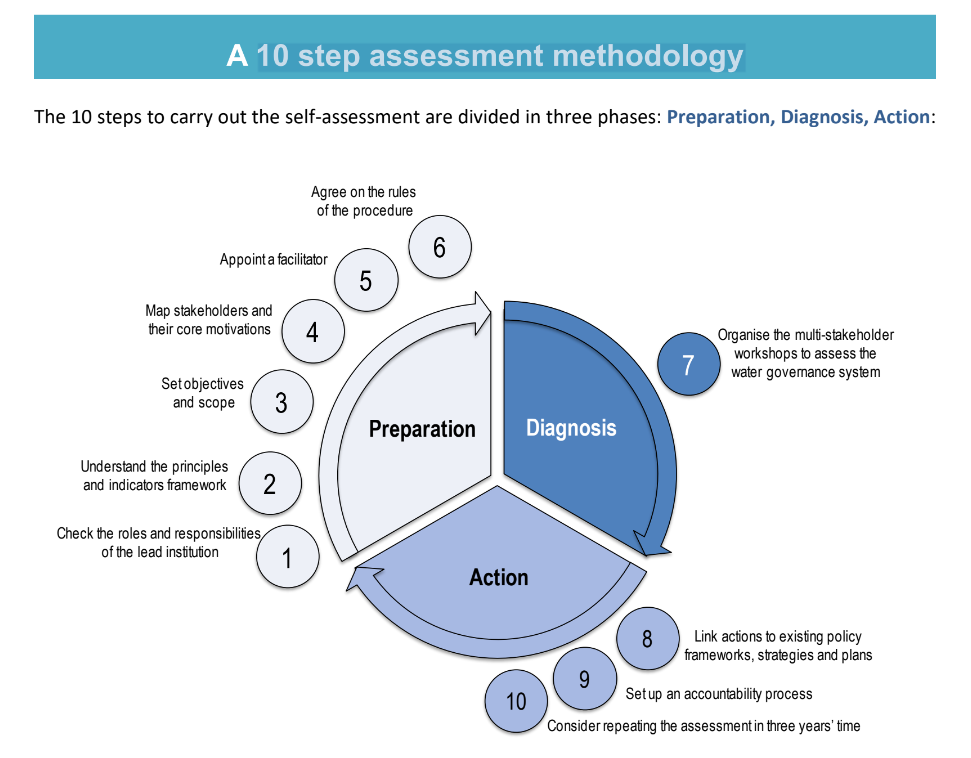
The OECD Water Governance Indicator Framework aims to support the implementation of the OECD Principles on Water Governance (OECD, 2015). The Principles provide 12 must-haves for efficient, effective and inclusive water governance. Adopted in May 2015 by the OECD Regional Development Policy Committee and backed by ministers at the OECD Council Meeting at Ministerial Level in June 2015, as a framework to guide better water policies and reforms.
The Principles apply to the overarching water policy cycle and should be implemented in a systemic and inclusive manner. As such, they do not make distinctions across: water management functions (e.g. drinking water supply, sanitation, flood protection, water quality, water quantity, rainwater and stormwater); water uses(e.g. domestic, industry, agriculture, energy and environment); and ownership of water management, resources and assets (e.g. public, private, mixed).

دسته‌ها

An Agenda for Water Action

چکیده:

The United Nations and World Bank Group convened a High Level Panel on Water (HLPW) to provide leadership in tackling one of the world’s most pressing challenges – an approaching global water crisis. As leaders of our organizations, the challenge we put before the Panel was to identify ways in which the world could accelerate progress towards ensuring the availability and sustainable management of water and sanitation for all (SDG 6) as well as to contribute to the achievement of the multiple SDGs that also depend on the development and adequate management of our planet’s water resources and thereby achieve the 20301 Agenda.

دسته‌ها

A systematic review on the role of trust in the water governance literature

چکیده:

Trust is generally considered to play a key enabling role in water governance. Despite this notion, there have been no systematic assessments examining the way in which the literature on water governance engages with ‘trust’. Our article fills this gap by providing an overview of the way in which this literature has engaged with trust as a conceptual lens, analytical device and empirical phenomenon. Through an explorative systematic literature review of N = 200, mainly peer-reviewed journal articles, our findings reveal that the knowledge base on the role of trust in water governance is fragmented, poorly conceptualized, and contextually dispersed. We also observe that the role of trust is often understudied, especially in the context of the global south and with regard to ethnic minorities and indigenous people as the subjects of trust. We recommend that future research should build on solid empirical evidence, diversify its foci, go beyond an instrumental approach to trust and rely on clear and transparent conceptualizations that acknowledge the context-specific and dynamic nature of trust relationships. The results of this review should serve to better systemize future research and to further the understanding on the role(s) of trust in varying contexts and related to different water governance issues.